
I’m going to throw my Mac into the Thames if one more person just copy and pastes a ChatGPT response into an email. At least reformat it so it looks like you know what you’re talking about. We’re deep into a corporate content crisis, and I’m guessing you know exactly what I’m talking about.
So many pieces of communication I get now (from emails at work to reading captions on Instagram) read like they’ve been edited by an algorithm. The tone is smooth, the grammar is flawless, the em dashes are rife and the entire thing lacks any sense of personality (or thought-leadership). It’s all buzzword language that’s technically perfect but lacks any ✨flavour✨.
And that, my friends, is why I’ve come to lvoe the humble, beautiful, handmade typo.
A typo used to be a little mark of shame. A red flag waving above your name ‘Careless! Rushing! Needs a Proofreader! Lacks Attention to Detail!’ But in this new, aggressive landscape of AI-driven copy, for me, the meaning has flipped.
A typo is now an unintentional badge of honour. It’s the signature of a human brain operating at speed, wrestling with a real thought, and using their own two hands on the keyboard. It means someone was actually invested enough in the context of what they were saying to bash it out themselves. It says:
I wrote this. I own it. And I can talk about it for longer than thirty seconds without running back to my AI for a cheat sheet or thought-starter.
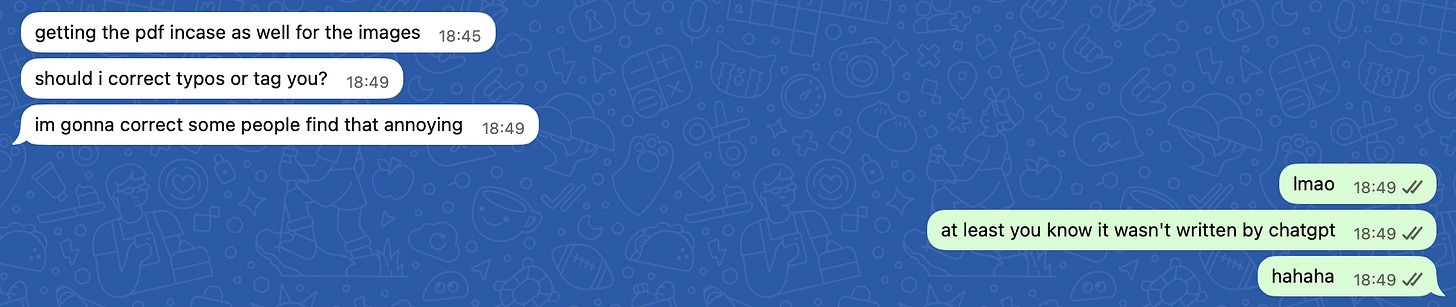
I didn’t know what to put as an image for this article, so I searched my phone for ‘typo’. I thought my connection to a typo and ChatGPT was relatively new - turns out I’ve been thinking it since August.
Typos are the new artisanal imperfection that prove you’re present in the moment. Send me a topline email with an obvious slip-up that features a sound idea, and I will trust that sender more than someone who drops a technically perfect five-paragraph GPT response that reads like a LinkedIn thought-leader just threw up on my inbox.
My thesis (and I’m sticking to it for the foreseeable) is that if you’re emails read like ChatGPT, you’re not thinking, you’re just generating. Boo you.
Side note: I’m not advocating for negligence, obviously. Little errors are the only evidence we have left that the lights are truly on inside.